
How to Choose Boutique Strat Pickups
Technical guide to choosing boutique Strat pickups based on era, wire type, DCR, magnet spec, calibration, and construction philosophy.
3/1/20263 min read
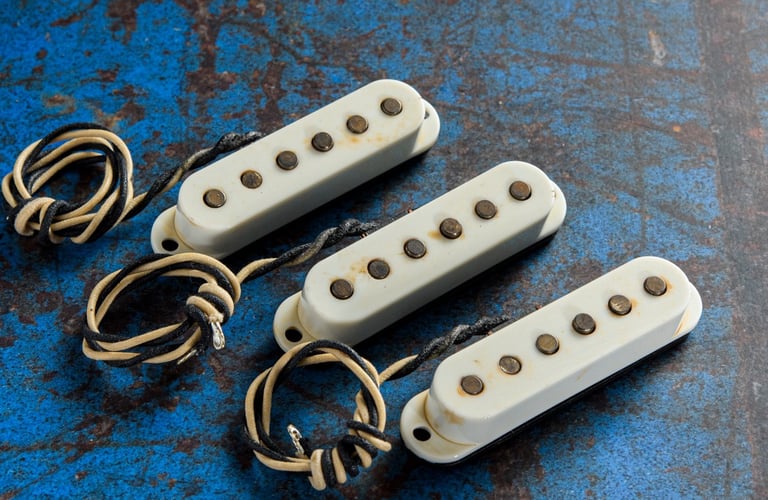
Once you move beyond factory replacements and into small-batch, historically informed builds, the decision becomes more specific. You are no longer choosing between “good” and “bad.” You are choosing between different era targets, calibration philosophies, and construction priorities.
Most serious boutique Strat sets operate within traditional vintage output territory. The meaningful differences are found in era reference, coil specification, magnet choice, and manufacturing method, not exaggerated output claims.
This is a structured way to approach the decision.
1. Define the era first
Before comparing brands, define the period you are aiming for.
Late 1950s orientation
Typically associated with:
Heavy Formvar wire
Moderate vintage output
Open high end
Slightly softer bass response
Greater elasticity under clean playing
A documented example is the Mojo 59 Stratocaster N.O.S Heavy Formvar Set from Mojo Pickups.
Published specifications include:
November 1958 REA Heavy Formvar wire
0.188" Alnico 5 magnets
Punched bobbins
Nitrocellulose lacquer dipping
Wax potting using black bee and paraffin blend
Neck 5.8k (2.34H), Middle 6.0k (2.35H), Bridge 6.2k (2.54H)
This places it firmly in late-1950s Fender specification territory with clearly documented material choices.
Early to mid 1960s orientation
Typically associated with:
Slightly tighter low end
Incrementally stronger mid presence
More structured positional balance
Upper-end vintage wind range
A documented example is the Mark Foley 62-63-64 Veneer Board Stratocaster Pickup Set.
Published specifications include:
0.187" Alnico 5 magnets
Custom Heavy Formvar coil wire
Vintage stagger with lowered G pole
DCR approximately 6k
Designed to sit at the upper end of the vintage wind range
This clearly positions it in early-to-mid 1960s veneer board era specification.
The 60 Archive from Sunbear Pickups also operates within an early-to-mid 60s historical framework using period-informed materials.
The 64S from Ron Ellis Pickups is positioned around mid-1960s references with careful set calibration. Ron Ellis does not publicly publish DCR figures for this model.
2. Published specification comparison
Below is a strictly factual overview using only builder-published information.
Model: Mojo 59 N.O.S.
Era: 1959
Wire: Nov 1958 REA Heavy Formvar
Bridge DCR: 6.2k
Model: Mark Foley 62-63-64
Era: 1962–1964
Wire: Heavy Formvar
Bridge DCR: ~6k
Model: Grinning Dog “Mr. Jimmy”
Era reference: Late-period Strat
Wire: 42 AWG Heavy Formvar
Bridge DCR: 6.5k
Model: Ron Ellis 64S
Era: Mid-1960s
Wire: Period-correct specification
Bridge DCR: Not publicly specified
The Grinning Dog In the Evening “Mr. Jimmy” Stratocaster Set is specified as:
42 AWG Heavy Formvar wire
Alnico 5 magnets
Neck 6.3k (approx. 8,200 turns)
Middle 6.3k (approx. 8,200 turns)
Bridge 6.5k (approx. 8,500 turns)
It sits slightly higher within traditional vintage territory without entering overwound output levels. None of the above are high-output modern designs. All remain within historically grounded Strat specifications.
3. Match the pickup to your guitar’s baseline
Your Strat has an inherent tonal profile before any pickup change.
Alder body with rosewood board
Often balanced. Early-to-mid 60s style sets such as the Mark Foley 62-63-64 or Ron Ellis 64S can maintain clarity with structured response.
Ash body with maple board
Often brighter and more immediate. A late-50s specification such as the Mojo 59 Heavy Formvar may preserve openness while avoiding excessive mid density.
If you prefer slightly more push within vintage limits, a bridge wound around 6.5k such as the Grinning Dog “Mr. Jimmy” sits toward the upper edge of vintage wind ranges.
The objective is proportional response within your instrument, not maximum output.
4. Evaluate the set only after setup is controlled
A Strat pickup set is designed as a calibrated system. However, perceived imbalance between positions is frequently caused by setup rather than pickup design.
Before judging calibration:
Control pickup height
Even 1–2 mm difference significantly affects perceived output and bass response. Bridge pickups often require closer positioning due to reduced string excursion.
Check for magnetic pull
Neck pickups set too high can exaggerate output and introduce pitch artifacts.
Account for string gauge and material
Heavier strings drive the pickup differently.
Verify wiring and pot values
Capacitor values, bridge tone wiring, and pot resistance affect perceived brightness and balance.
Only after height and setup are properly adjusted should you evaluate:
Positional coherence
Transition between neck, middle, and bridge
Behaviour of positions 2 and 4
Overall set balance
Builders differ in approach. Ron Ellis Pickups are associated with careful calibration. Mojo Pickups emphasize historically correct materials and manufacturing methods, including the use of period-correct N.O.S. wire in certain models. Sunbear Pickups operate within historically informed small-batch frameworks.
These are differences in philosophy, not superiority.
5. Construction details that justify boutique pricing
In this tier, price differences typically reflect:
Magnet sourcing and treatment
Coil wire type and insulation
Manufacturing method (punched vs laser-cut bobbins)
Lacquer dipping vs modern finishing
Documented historical replication
For example, the Mojo 59 N.O.S Heavy Formvar set specifies:
November 1958 REA magnet wire
In-house beveled magnets
Nitrocellulose dipping
Wax potting blend
The Mark Foley veneer board set documents magnet diameter, stagger pattern, and vintage-range DCR targets.
The Grinning Dog “Mr. Jimmy” clearly publishes AWG, turn count, and resistance.
These are measurable construction details, not marketing descriptors.
Final framework
When choosing boutique Strat pickups, define:
The era target
The wind range within vintage territory
Your guitar’s tonal baseline
Your amp’s voicing
Whether you prioritize strict historical material replication or calibrated structural balance
Once those points are defined, the shortlist becomes technical and manageable.
Boutique Guitar Pickups is an authorized EU distributor for these brands. All listed sets are physically in stock in Vilnius, Lithuania and ship within the EU without additional import VAT.
Contact us:
Subscribe to our newsletter
info@boutiqueguitarpickups.com